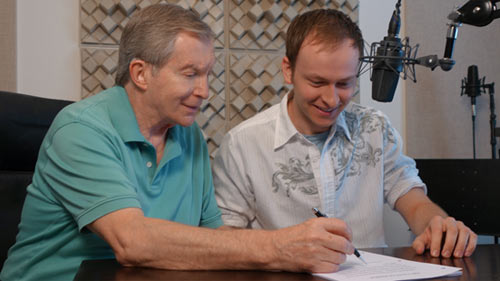
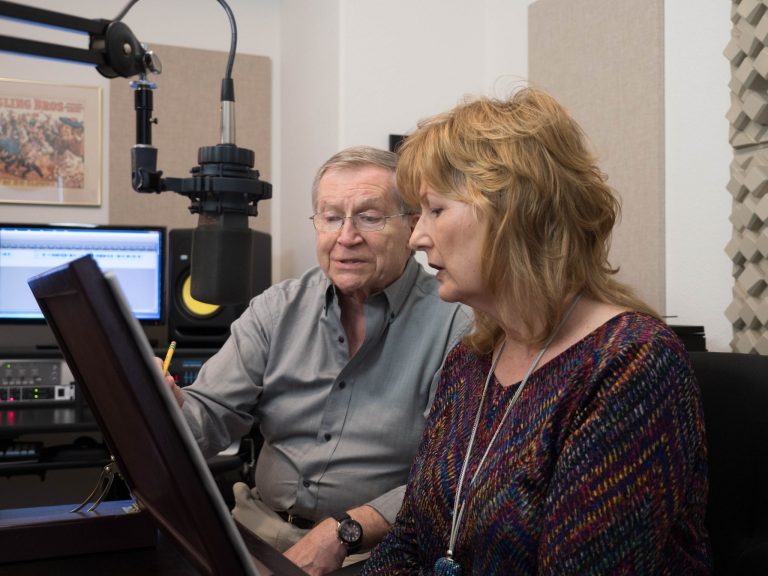
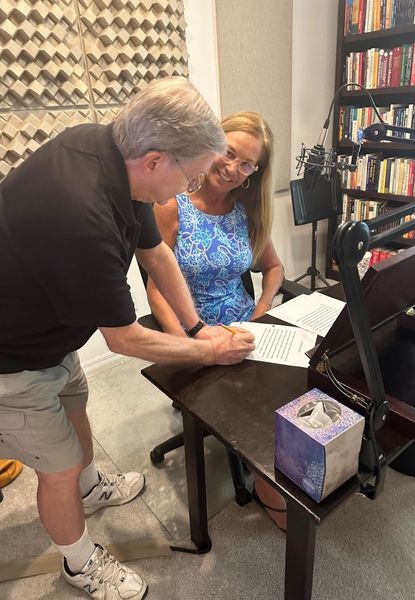
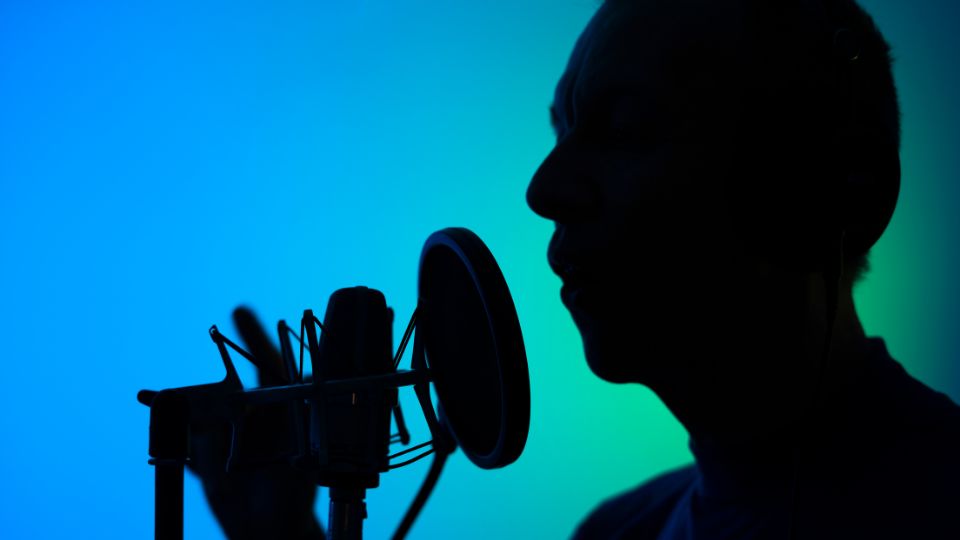
My voice acting coaching program in entirely one-on-one.
Following the evaluation session that I require of all my students, the outcome of which has been positive, the student and I begin a regimen of one-on-one instruction.
The first lesson is longer (1½ hours), since there is much to discuss. I begin a discussion about the fundamentals of script delivery, always pointing out the vast differences between the ways most people read aloud vs. the ways people talk. This includes reading assignments for the next session and thereafter in my reference book, The Voice Over Handbook. I will also explain the basics of marking the script for emphasis and pauses.
We then move on to performing the scripts, one by one.</p.
Before we begin, I ask the student to tell me in one sentence what the script is about. Most of the time, in the early stages of voice acting training, the student cannot answer that question definitively.
Next, I let the student read through the entire script without interruption or critique. At the end of the read, I give the student some general critique about smooth or uneven delivery, and why I am hearing one or the other. In the next read of the script, my critique is more detailed, and I may stop frequently to go over the lines that need work, while defining problems and offering solutions as they occur. Finally, we go back and do another read to get the performance smoother and more natural. From there, we move on to the next script, and the process goes on, as before.
The student will take home the recording of the entire session to use in his or her practice time (or will have recorded it on Zoom, if the lesson was online).
Most of the week’s practice time will be spent on refining what has been critiqued in the lesson.
The day before the next lesson, the student will look over and mark, to the best of his or her ability, the scripts that will be read in the next lesson.
From then on, at the beginning of each lesson, before the student reads each script, we will go over his or her script markings and correct them, as necessary, and I will explain the how and why of the corrections.
Over time, in each of these voice over training sessions, a gradual understanding and mastery of the process will begin to emerge, and the student will be on the road to becoming an accomplished voice over actor.